

How much can i earn in affiliate marketing. Let’s see.
IGLC Industry Research | 28 October 2026 | International Salary & Compensation Analysis
From Junior Affiliate Managers to CMOs: comparing recruitment reports, international salary benchmarks, performance bonuses and the real economics behind compensation.
The iGaming industry measures almost everything.
Operators track acquisition costs, first-time depositors, deposit volumes, player value, NGR, ROAS and retention across multiple markets. Affiliate departments are expected to explain not only how many players they acquire, but also how efficiently they spend their budgets.
Yet when it comes to the salaries of the people responsible for these results, the industry is far less transparent.
How much should a Junior Affiliate Manager earn? Why does a Senior sometimes make almost as much as a Team Lead? And why can a CMO earn twice as much as a Head of Affiliates, even when affiliate marketing is one of the operator’s most important acquisition channels?
To investigate these questions, IGLC — iGaming Leaders Council compared compensation estimates from Boston Link, Pentasia, SpinHire and IGLC’s own research.
We also examined a performance-based compensation framework, with all monetary figures adjusted upward by 20%, to understand how bonuses affect total earnings.
The objective is not to declare one universal salary for every position. It is to understand where sources agree, where they disagree and what those differences tell us about the value of affiliate professionals.
1. The six positions we are comparing
| Position | Main responsibility | Primary value |
|---|---|---|
| Junior Affiliate Manager | Partner support, onboarding and reporting | Learning and execution |
| Middle Affiliate Manager | Independent partner management | Acquisition growth |
| Senior Affiliate Manager | Major partnerships and complex negotiations | Commercial performance |
| Affiliate Team Lead | Team targets, coaching and management | Collective performance |
| Head of Affiliates | Acquisition strategy, budgets and department management | Channel profitability |
| CMO | Overall marketing strategy and resource allocation | Company-wide marketing performance |
The differences matter because salary is not simply a function of experience.
A Senior managing several high-value partners may have greater commercial influence than a Team Lead managing a small department.
Similarly, a Head of Affiliates overseeing multiple brands may carry responsibilities that overlap with those of a CMO at a smaller operator.
2. IGLC international salary estimates for 2026
We begin with IGLC’s international salary estimates, which cover all six positions.
Table 1. Estimated monthly gross base salary
| Position | Monthly salary | Annual salary |
|---|---|---|
| Junior Affiliate Manager | €2,400 | €28,800 |
| Middle Affiliate Manager | €3,500 | €42,000 |
| Senior Affiliate Manager | €5,300 | €63,000 |
| Affiliate Team Lead | €6,000 | €72,000 |
| Head of Affiliates | €8,500 | €102,000 |
| CMO | €13,000 | €156,000 |
Source: IGLC salary estimates, October 2026. Senior monthly salary rounded from €5,250. Annual equivalent calculated using the original amount. Estimates, not independently verified global averages.
Figure 1. IGLC International Salary Estimates 2026
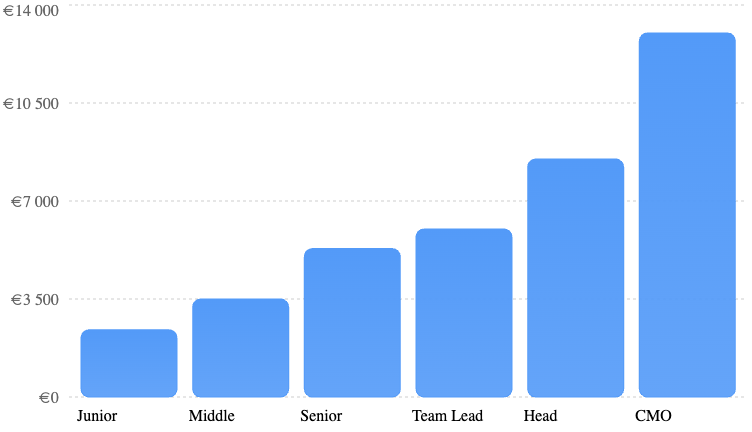
EUR per month, excluding performance bonuses. Values use full euro amounts rather than K notation.
Two things immediately stand out.
First, the salary increase between Senior and Team Lead is relatively small, despite the significant increase in managerial responsibility.
Second, the gap between Head of Affiliates and CMO is much larger.
These two transitions deserve particular attention because they reveal how the industry values individual commercial performance compared with organisational leadership.
3. How do IGLC estimates compare with Boston Link and SpinHire?
Malta is one of the most established iGaming employment markets in Europe, making it a useful starting point.
Boston Link’s Malta salary report provides benchmarks for Middle and Senior Affiliate Managers, Heads of Affiliates and CMOs.
SpinHire adds regional estimates for other career levels.
Table 2. International and Malta salary comparison
| Position | IGLC international | Boston Link Malta | SpinHire Malta/Cyprus |
|---|---|---|---|
| Junior | €2,400 | — | €2,500 |
| Middle | €3,500 | €3,800 | €3,900 |
| Senior | €5,300 | €4,600 | €6,000 |
| Team Lead | €6,000 | — | €5,500–7,500 |
| Head of Affiliates | €8,500 | €7,100 | €6,500–14,000 |
| CMO | €13,000 | €15,000 | — |
Monthly EUR benchmarks, rounded. SpinHire’s leadership ranges and salary definitions differ from its gross regional database. These sources should not be treated as identical samples.
Figure 2. IGLC vs Boston Link Malta
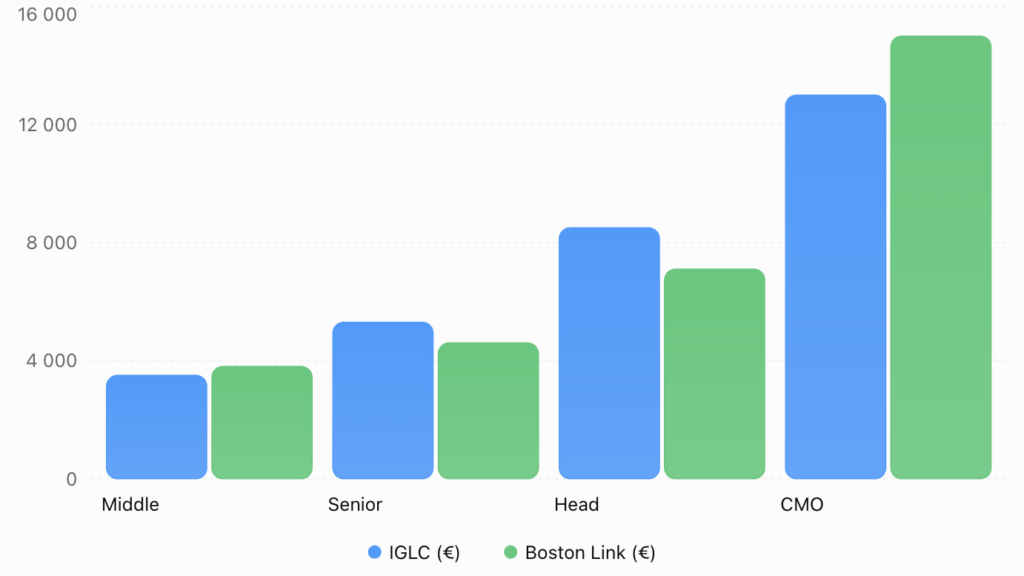
Blue – IGLC (€)
Green – Boston Link (€)
The differences are meaningful.
Boston Link places Middle Affiliate Managers slightly above the IGLC estimate, while its Senior and Head benchmarks are lower. For CMOs, Boston Link reports a higher figure.
This does not necessarily mean that one source is correct and another is wrong.
Different recruitment reports may reflect different employer populations, company sizes, job responsibilities and compensation definitions.
A Head of Affiliates managing one brand is not necessarily comparable to a Head responsible for several brands, numerous GEOs and a large acquisition budget.
The same applies to CMOs.
Salary benchmarking without understanding organisational scope can produce misleading conclusions.
4. What does the Pentasia Salary Survey tell us?
Pentasia provides another useful industry-specific reference.
Its salary research, published through iGB, includes broader marketing and executive benchmarks.
Table 3. Pentasia industry salary benchmarks
| Position | Annual salary | Monthly equivalent |
|---|---|---|
| Affiliate Manager | £60,000 | £5,000 |
| Head of Affiliates | £85,000 | £7,100 |
| CMO | £155,000 | £12,900 |
Source: iGB/Pentasia Salary Survey 2025. Monthly equivalents rounded to £100. Industry-wide figures, not UK-only averages.
The Pentasia data reinforces the substantial difference between Heads of Affiliates and CMOs.
However, it also illustrates a common limitation of salary reports: Affiliate Managers are frequently grouped into one category.
Junior, Middle and Senior professionals may have dramatically different responsibilities, yet their salaries are sometimes combined.
Team Leads are also frequently omitted or grouped with Heads.
This makes it difficult to understand career progression using recruitment reports alone.
5. International salary differences: Malta, Poland, Ukraine, the UK and the US
Geography plays a major role in compensation.
But comparing countries requires caution because local employment structures, taxes, B2B arrangements and the availability of international remote positions can change the picture significantly.
SpinHire’s regional data provide a useful comparison.
Table 4. Regional affiliate salary benchmarks
| Position | Malta + Cyprus | Poland + Romania + Baltics | Kyiv + Tbilisi + Yerevan |
|---|---|---|---|
| Junior | €2,500 | €1,800 | €900 |
| Middle | €3,900 | €2,900 | €1,300 |
| Senior | €6,000 | €4,500 | €1,900 |
| Head / Lead combined | €9,800 | €7,000 | €2,900 |
SpinHire regional gross monthly salary estimates, rounded. These are regional groupings rather than country-specific salary averages. The Head/Lead category is not a separate Team Lead benchmark.
Figure 3. Regional Affiliate Salary Comparison
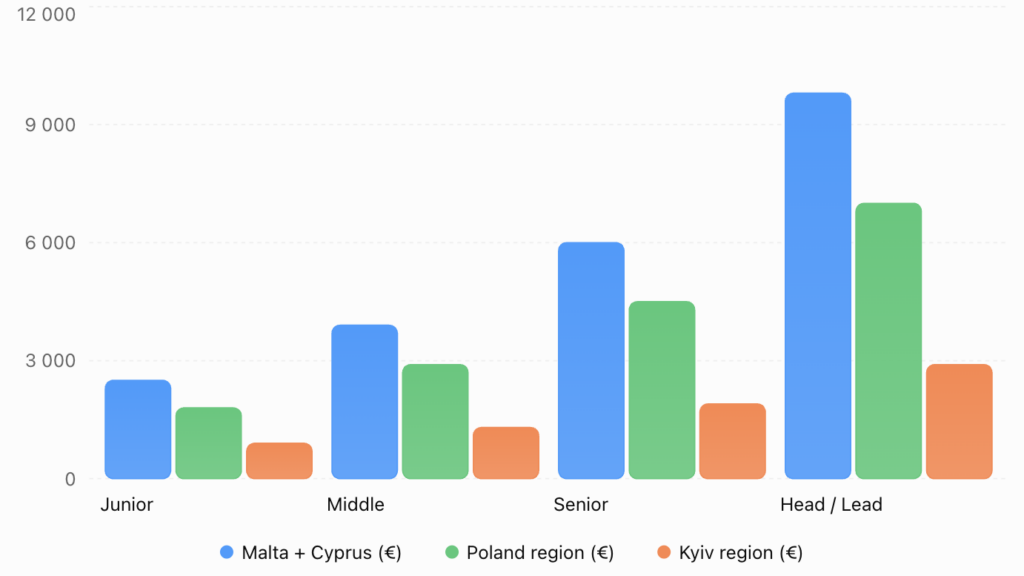
Blue – Malta + Cyprus (€)
Green – Poland region (€)
Orange – Kyiv region (€)
The geographic differences are substantial.
A Middle Affiliate Manager in the Malta/Cyprus group earns approximately 34% more than the equivalent regional benchmark in Poland.
The difference is much larger when compared with the Kyiv/Tbilisi/Yerevan group.
But these figures do not measure the commercial value of an employee.
An experienced Ukrainian Senior working for an international operator may earn considerably more than the local benchmark.
Likewise, a Polish Team Lead managing a multinational acquisition department may receive compensation far above the regional average.
The figures describe different labour markets, not different levels of professional competence.
Additional UK and US benchmarks
Historical Pentasia research provides further reference points.
| Market | Affiliate Manager annual salary | Monthly equivalent |
|---|---|---|
| United Kingdom | £52,700 | £4,400 |
| United States | $73,500 | $6,100 |
These are historical Affiliate Manager averages, not separate Junior, Middle and Senior figures.
The US market also includes higher advertised salaries for experienced specialists and leadership positions. Such vacancies demonstrate the range of available compensation but should not be mistaken for national averages.
Table 5. What the five-market evidence supports
| Market | Reference | Monthly salary | Limitation |
|---|---|---|---|
| Malta | Boston Link Middle | €3,800 | Malta-specific |
| UK | Historical Pentasia Affiliate Manager | £4,400 | No seniority breakdown |
| US | Historical Pentasia Affiliate Manager | $6,100 | No seniority breakdown |
| Poland region | SpinHire Middle | €2,900 | Several countries combined |
| Ukraine region | SpinHire Middle | €1,300 | Several countries combined |
The conclusion is that international salary differences are real, but published benchmarks are not sufficiently consistent to establish a reliable six-position average for each individual country.
6. The missing part of salary reports: performance bonuses
Most salary comparisons focus on fixed compensation.
But affiliate marketing is a performance-driven profession.
A Senior Affiliate Manager may receive a significant bonus linked to commercial performance.
A Team Lead may receive a larger variable component because they are responsible for the performance of several managers.
And a Head of Affiliates may negotiate incentives linked to department profitability.
To understand how bonuses change compensation, IGLC reviewed an internal remuneration framework covering Junior, Middle, Senior and Team Lead positions.
For this research, all monetary figures were increased by 20% and rounded for readability.
These are adjusted compensation scenarios, not verified market-wide averages.
Table 6. IGLC compensation scenario — Ukraine and emerging markets
Monthly USD gross, adjusted +20%
| Position | Base salary | Average bonus | Average total | Maximum total |
|---|---|---|---|---|
| Junior | $2,000 | $500 | $2,500 | $4,900 |
| Middle | $3,400 | $1,300 | $4,700 | $8,400 |
| Senior | $4,400 | $1,800 | $6,100 | $10,900 |
| Team Lead | $5,200 | $4,700 | $10,000 | $13,100 |
Table 7. IGLC compensation scenario — Poland and developed markets
Monthly USD gross, adjusted +20%
| Position | Base salary | Average bonus | Average total | Maximum total |
|---|---|---|---|---|
| Junior | $2,300 | $600 | $2,900 | $5,800 |
| Middle | $3,800 | $1,500 | $5,400 | $9,600 |
| Senior | $5,000 | $2,000 | $7,100 | $12,600 |
| Team Lead | $6,000 | $5,400 | $11,400 | $15,000 |
Source: IGLC adjusted compensation scenario, October 2026. Original internal monetary values increased by 20%. Displayed amounts rounded to $100; independently rounded components may not sum exactly to rounded totals.
Figure 4. Average Total Monthly Compensation by Region
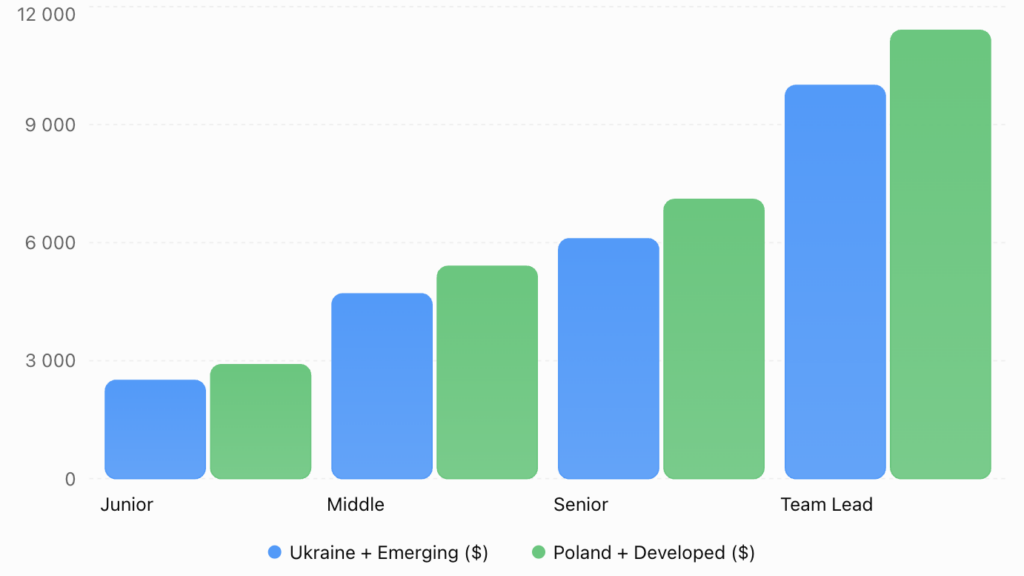
Blue – Ukraine + Emerging ($)
Green – Poland + Developed ($)
The difference between base salary and total compensation becomes especially important at Team Lead level.
In the developed-market scenario, average total compensation rises from approximately $7,100 for a Senior to $11,400 for a Team Lead.
That is a 61% increase.
The reason is not a dramatic increase in fixed salary. It is the bonus structure.
7. Why is the Senior-to-Team-Lead salary increase so small?
According to IGLC’s international estimates, a Senior Affiliate Manager earns €5,250 per month, while a Team Lead earns €6,000.
That represents an increase of approximately 14%.
For this relatively modest increase, the employee may become responsible for recruitment, coaching, performance management, commercial approvals and the results of an entire team.
This raises an important question.
Why would a high-performing Senior accept significantly more responsibility for such a small increase in guaranteed compensation?
Figure 5. Salary Increase at Each Career Transition
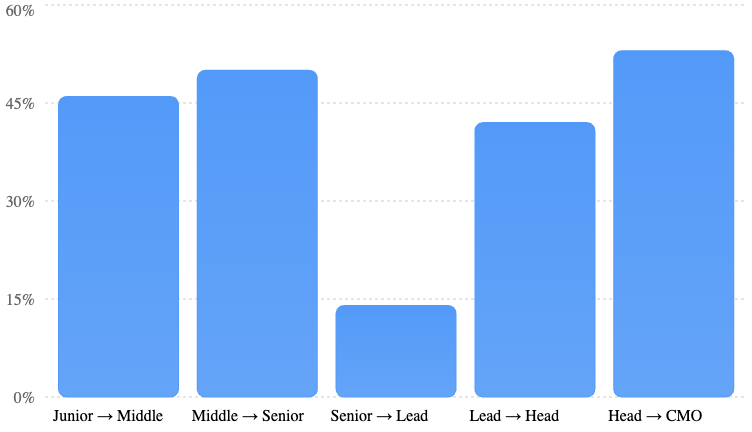
The Senior-to-Team-Lead transition has the smallest base salary increase on the entire career ladder.
There are several possible explanations.
First, experienced Senior Affiliate Managers can be extremely valuable individual contributors.
They may manage major acquisition partners, negotiate profitable agreements and maintain commercial relationships that would be difficult to replace.
Second, a newly promoted Team Lead may still be developing management skills.
The company may therefore initially value the Senior and Team Lead positions similarly in terms of guaranteed salary.
Third, leadership compensation may be structured around larger performance bonuses.
Table 8. Senior vs Team Lead: the effect of bonuses
| Position | Base salary | Average bonus | Average total |
|---|---|---|---|
| Senior | $5,000 | $2,000 | $7,100 |
| Team Lead | $6,000 | $5,400 | $11,400 |
| Difference | +20% | +170% | +61% |
IGLC adjusted developed-market compensation scenario. USD gross per month.
Figure 6. Senior vs Team Lead: Base Salary and Average Bonus
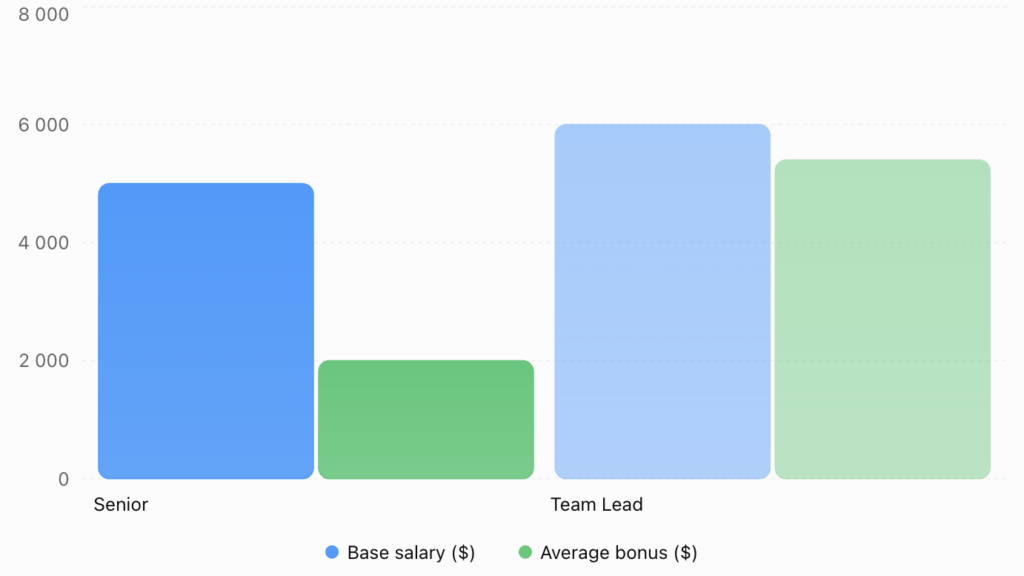
Blue – Base salary ($)
Green – Average bonus ($)
In this model, the Team Lead’s base salary is 20% higher, but average total compensation is approximately 61% higher.
This reflects the concept of management leverage.
A Senior primarily improves the performance of their own partner portfolio.
A Team Lead can improve the performance of several employees simultaneously.
Better coaching, stronger commercial discipline, improved partner allocation and earlier intervention when performance deteriorates can benefit the entire department.
But the model also creates a potential problem.
A Team Lead’s results depend on employees, budgets, product performance and market conditions. These factors are not always fully within the leader’s control.
If most of the salary increase is variable, the employee may accept significantly more responsibility without receiving a proportionate increase in guaranteed income.
IGLC’s conclusion: Team Lead compensation should reward collective performance while recognising the additional responsibility and risk of managing people.
8. Why does a CMO earn so much more than a Head of Affiliates?
The second major contradiction appears at the top of the career ladder.
IGLC estimates approximately €8,500 per month for a Head of Affiliates and €13,000 for a CMO.
Boston Link’s Malta figures suggest an even larger gap: approximately €7,100 versus €15,000.
Pentasia also reports a substantial difference.
Table 9. Head of Affiliates vs CMO
| Source | Head of Affiliates | CMO | CMO premium |
|---|---|---|---|
| IGLC international | €8,500 | €13,000 | +53% |
| Boston Link Malta | €7,100 | €15,000 | +112% |
| Pentasia industry-wide | £7,100 | £12,900 | +82% |
Monthly salary equivalents. Percentages calculated from original unrounded figures.
Figure 7. CMO Salary Premium Over Head of Affiliates
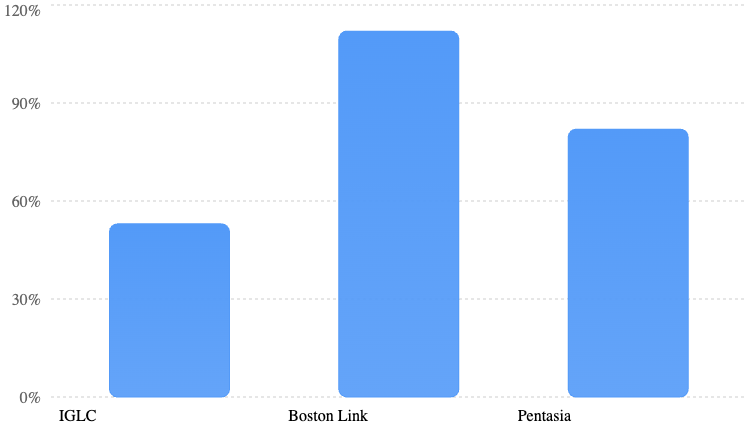
Why is the difference so large?
The conventional explanation is that a CMO is responsible for a broader marketing function.
A Head of Affiliates manages affiliate acquisition. A CMO may oversee affiliates, PPC, SEO, CRM, retention, brand marketing and overall marketing budgets.
In theory, the CMO makes decisions that affect the entire marketing organisation.
But the reality is more complicated.
In an affiliate-driven operator, the Head of Affiliates may control one of the largest acquisition budgets and manage partnerships responsible for a significant share of new depositing players.
The Head may also be responsible for acquisition profitability, market expansion and commercial forecasting.
At what point does that responsibility begin to resemble the work of a CMO?
Table 10. Head of Affiliates vs CMO responsibilities
| Responsibility | Head of Affiliates | CMO |
|---|---|---|
| Affiliate partner strategy | Primary owner | Strategic oversight |
| Affiliate acquisition budget | Primary owner | Cross-channel allocation |
| Affiliate team management | Primary owner | Organisational oversight |
| PPC, SEO and paid media | Coordination | Usually strategic owner |
| CRM and retention | Coordination | Often strategic owner |
| Marketing profitability | Affiliate channel | Across marketing channels |
| Marketing strategy | Channel-specific | Company-wide |
| Executive-level resource allocation | Usually limited | Core responsibility |
A CMO’s higher compensation can be justified when the role genuinely involves larger budgets, multiple departments and company-wide strategic responsibility.
But that explanation becomes weaker when a Head of Affiliates already performs many of those functions.
The real difference should be measured through decision-making authority, financial responsibility and organisational scope — not just job titles.
9. The missing variable: how much value does the employee create?
One weakness of traditional salary benchmarking is that compensation is rarely evaluated alongside commercial performance.
Imagine two Senior Affiliate Managers.
Both have five years of experience. Both manage a similar number of partners. Both work for casino operators.
But their acquisition results differ significantly.
Table 11. Two managers, different commercial outcomes
| Metric | Manager A | Manager B |
|---|---|---|
| First-time depositors | 200 | 150 |
| Acquisition cost | €40,000 | €30,000 |
| First-month deposits | €50,000 | €60,000 |
| Cost per FTD | €200 | €200 |
| First-month deposits per FTD | €250 | €400 |
| Deposit ROAS | 125% | 200% |
Hypothetical IGLC example. Deposit ROAS = first-month deposits divided by acquisition cost. It is not a profitability measure.
Manager A acquires more players.
Manager B acquires fewer players but generates higher first-month deposits with lower acquisition spending.
If the company rewards only FTD volume, Manager A may appear more successful.
If it evaluates acquisition efficiency, Manager B performs better in this example.
However, deposits are not the same as profit.
The operator must also consider GGR, NGR, bonus costs, provider fees, retention and long-term player value.
The cause-and-effect relationship
1. Partner Selection and Commercial Terms
Traffic sources, GEOs, CPA/RevShare agreements
2. Acquisition Quality and Efficiency
FTDs, acquisition costs, ADPU and traffic quality
3. Player Economics
Retention, GGR, NGR and contribution margin
4. Sustainable Business Performance
Profitable growth supporting bonuses and career progression
Better partner selection and commercial negotiations can improve acquisition efficiency.
Better acquisition efficiency can improve cohort economics.
Better cohort economics can contribute to sustainable business performance.
But not every part of this process is controlled by the Affiliate Manager.
Product conversion, payment acceptance, retention campaigns and market conditions also influence results.
A fair compensation system should reward performance while recognising which factors the employee can actually influence.
10. What should affiliate bonuses be based on?
Bonus systems influence employee behaviour.
If a company rewards only FTD volume, managers may prioritise acquiring more players regardless of acquisition costs.
If it rewards only deposits, managers may focus on volume without considering profitability.
If it rewards only short-term ROAS, managers may avoid partnerships that offer stronger long-term value but slower initial payback.
Table 12. Comparing affiliate bonus metrics
| Bonus metric | What it encourages | Potential risk |
|---|---|---|
| FTD volume | More new depositing players | Expensive or low-value traffic |
| Deposit sum | Higher deposit activity | Deposits mistaken for profit |
| Deposit ROAS | Acquisition efficiency | Short-term optimisation |
| NGR | Revenue contribution | Volatility outside employee control |
| Contribution margin | Sustainable profitability | Complex attribution |
| Team performance | Collaboration and leadership | Dependence on colleagues |
The most appropriate bonus structure depends on the role.
Junior employees may be evaluated on execution and professional development.
Middle and Senior employees should increasingly be evaluated on commercial results.
Team Leads should be rewarded for collective performance and managerial effectiveness.
Heads should be evaluated on acquisition strategy, budgets and channel profitability.
CMOs should be evaluated on the broader performance of the marketing organisation.
The objective should be to reward behaviour that improves sustainable business results, not simply one metric.
11. How bonuses change career progression
The IGLC compensation scenario illustrates how variable compensation increases with seniority.
Table 13. Bonus structure by position
| Position | Base salary | Average total pay | Average bonus / base |
|---|---|---|---|
| Junior | $2,300 | $2,900 | 25% |
| Middle | $3,800 | $5,400 | 40% |
| Senior | $5,000 | $7,100 | 40% |
| Team Lead | $6,000 | $11,400 | 90% |
IGLC adjusted developed-market scenario, October 2026. Monthly USD gross.
Figure 8. Average Bonus as a Percentage of Base Salary
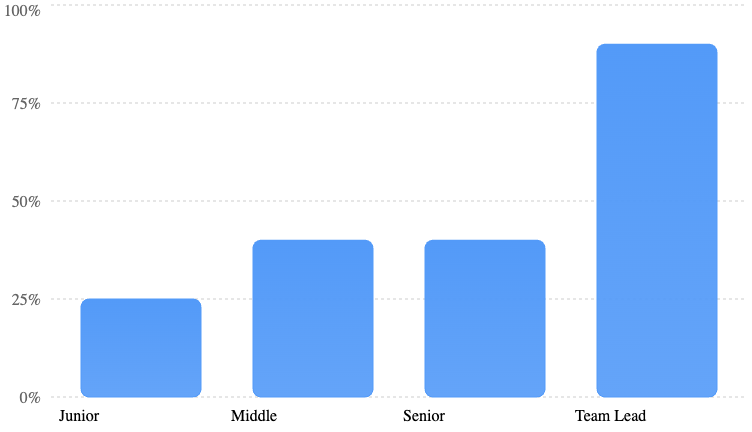
The biggest change occurs at Team Lead level.
For Junior, Middle and Senior employees, bonuses represent a meaningful but smaller component of expected earnings.
For Team Leads, variable compensation becomes central to the package.
This reflects the expectation that managers should improve the performance of other employees.
However, it also raises a question about how leadership performance should be measured.
A Team Lead who improves employee development, reporting quality and commercial processes may create long-term value that is not immediately reflected in monthly acquisition figures.
A purely short-term bonus model may fail to recognise these improvements.
12. What the research means for employees and employers
For employees, the most important lesson is to evaluate compensation as a complete package.
A higher base salary matters, but so do bonus conditions, performance targets and the realistic probability of achieving them.
A Senior considering promotion to Team Lead should evaluate both the guaranteed salary increase and the additional responsibility.
A Head considering a CMO position should examine whether the role genuinely includes broader strategic authority.
For employers, the research suggests that conventional salary bands are insufficient.
Compensation should reflect commercial responsibility, management complexity and measurable contribution to sustainable business performance.
This does not mean every successful Affiliate Manager should receive an executive salary.
It means salary decisions should be based on what the employee actually controls and delivers.
13. IGLC’s five key conclusions
1. Junior-to-Middle progression represents a major commercial transition.
The employee moves from supervised execution to independent partner management. This can justify a meaningful compensation increase.
2. Senior Affiliate Managers can be highly valuable without becoming people managers.
Strong commercial relationships and profitable acquisition performance can justify high compensation even without direct reports.
3. Team Lead compensation depends heavily on the bonus structure.
The IGLC model demonstrates how a relatively small increase in fixed salary can translate into a much larger increase in total compensation.
4. The Head-to-CMO salary gap reflects organisational scope, but not always commercial impact.
The difference is substantial across several sources. However, the responsibilities of Heads and CMOs can overlap in affiliate-driven operators.
5. There is no reliable single global salary average for every affiliate position.
Regional differences, inconsistent job definitions and incomplete salary disclosure make direct comparisons difficult.
14. Final verdict: the industry needs to rethink what it pays for
The iGaming industry measures acquisition performance with increasing precision.
Yet compensation is still frequently discussed through job titles, years of experience and salary ranges that do not fully reflect commercial responsibility.
A Junior Affiliate Manager should be rewarded for developing independent capabilities.
A Middle or Senior should be rewarded for sustainable commercial performance.
A Team Lead should be rewarded for improving the results of other people.
A Head of Affiliates should be rewarded for building and managing a commercially effective acquisition channel.
And a CMO should be rewarded for improving the performance of the wider marketing organisation.
Our comparison of Boston Link, Pentasia, SpinHire and IGLC estimates demonstrates how significantly salary benchmarks can differ.
The IGLC compensation scenario adds another dimension: bonuses can fundamentally change the apparent value of a position, particularly at Team Lead level.
For employees, this means looking beyond advertised base salaries.
For employers, it means aligning compensation with responsibility, controllable performance and sustainable business outcomes.
And for the industry, it means recognising that a job title is not a reliable substitute for understanding the commercial value a professional creates.
The question should not simply be how much an Affiliate Manager earns.
It should be whether their compensation reflects the responsibility they carry, the decisions they make and the value they help generate.
Research methodology and sources
Research compiled by IGLC · 28 October 2026
| Source | Contribution | Limitation |
|---|---|---|
| Boston Link Malta Salary Report 2026 | Malta salary benchmarks | Junior and Team Lead not separately covered |
| iGB/Pentasia Salary Survey 2025 | Industry-wide salary benchmarks | Limited seniority breakdown |
| SpinHire Affiliate Manager Salary Data | Regional salary estimates | Countries grouped together |
| SpinHire Affiliate Career Guide | Career progression and leadership estimates | Compensation definitions differ |
| IGLC International Salary Estimates | Six-position salary ladder | Editorial estimates |
| IGLC adjusted compensation scenario, October 2026 | Base salary, bonuses and maximum pay | Original internal model adjusted upward by 20% |
All salary amounts have been rounded for readability. Percentage calculations use original unrounded values where available.
The IGLC compensation scenario is presented separately from published market benchmarks because it includes variable compensation and uses different regional groupings.
The 20% uplift is a modelling adjustment, not a measured market-wide salary increase.
About IGLC
IGLC — iGaming Leaders Council is a private, invitation-only community connecting CMOs, Heads of Affiliates, Affiliate Directors and other senior decision-makers from the operator side of the iGaming industry.
Through private events, executive discussions and industry research, IGLC brings together professionals responsible for acquisition strategy, marketing performance and business growth.